Universal Machines.
- Entry
- Article 002
- Date
- Location
- Sydney, Australia
- Tags
- Computation, Instruments, Automation, Cognition, AI
In 1936, working at King’s College Cambridge, Alan Turing published a paper called On Computable Numbers, with an Application to the Entscheidungsproblem. He was twenty-three. The paper addressed a question in mathematical logic. Could there be a general procedure for deciding the truth of any mathematical statement? The answer was no.
To prove that no such procedure existed, Turing first had to define what a procedure was and what it would mean for a process to be mechanical, step-by-step, performable without insight.
In 1936 the word computer meant a person. For centuries, it had meant someone, usually a woman, whose job was to perform calculations by hand. Astronomical tables, ballistics trajectories, navigation almanacs. The work was procedural and exacting. Teams of human computers worked in observatories, military planning offices, universities, and government departments. Turing’s paper was, in its first form, a description of what those people did.
But a person was still too ambiguous. A human computer could remember, infer, improvise, or take shortcuts. To define procedure precisely, Turing had to remove everything personal from the act of calculation. What remained was a sequence of simple acts that could be followed without judgement.
He described a single device with a tape divided into squares, a read-write head moving along the tape, and a set of instructions telling the head what to do at each step. By changing only the instructions, the machine could perform any calculation that could be precisely described. The instructions were the procedure a human computer would have followed. The tape and the head were the paper and pencil. Turing had not invented the activity. He had formalised it.
The capability was general. The purpose would come later, supplied by whoever wrote the instructions. What constrained the machine was rarely the machine itself. It was what people could afford to ask of it, and beneath that, what they could imagine asking at all.
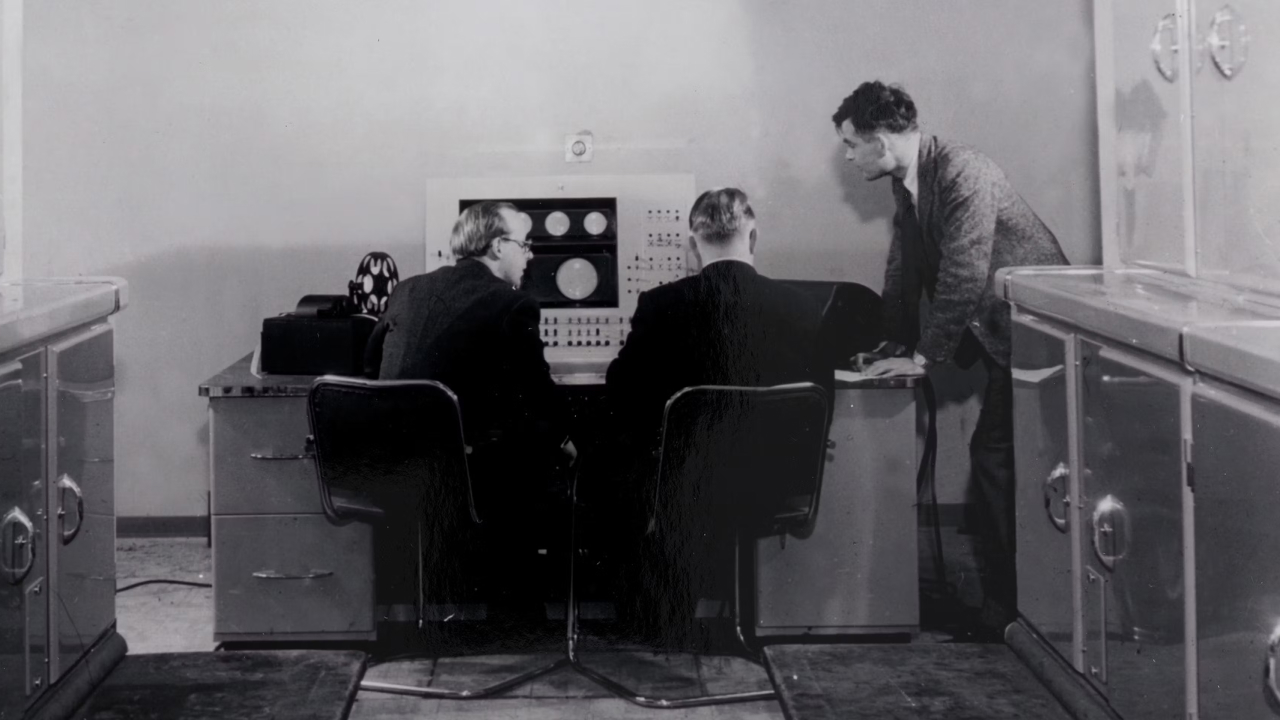
The next decades were spent making the machine real. Colossus. ENIAC. The Manchester Baby. Room-sized systems programmed by hand and used for calculations no person could perform at speed. The narrowness of that work was not a failure of imagination. Other uses had been visible almost from the start. They were simply uneconomical, and the machine went where it could pay for itself, first to calculation, then to the clerical work of payroll, billing, and records. As the cost fell, the range of things worth asking widened with it. Institutions mostly handed computing their existing processes and asked for them faster, cheaper, and more reliable. Existing work made the easy case, because its value was already known. Work that did not yet exist could not be priced at all.
As computing became cheaper, it also became an instrument people could think through. Excel did more than automate arithmetic. It turned financial models into something a person could explore, change, and recalculate in real time. New forms of financial planning grew around that surface for thought.
Photoshop did something similar for visual work. Retouching existed before Photoshop. What changed was the speed and fluidity of experimentation. Once ordinary people could composite, rework, and try again, an entire visual culture grew around the practice.
Real-time collaboration was the same pattern again. The shift from digital documents to shared editing was not primarily about speed. It changed the way groups think together. The software became a place where people reasoned in the open, while the thought was still forming.
Automation absorbs existing work. Instruments create the conditions for new kinds of work to emerge. The bookkeepers whose work was absorbed by payroll systems did not automatically become financial modellers. Financial modelling spread because the spreadsheet made models into things a bookkeeper could shape rather than only record. The instrument shaped the practice, and the practice evolved around the instrument. The gains compound when the tool lets people contribute in ways they could not before.
I have drawn that as a clean distinction, but useful tools rarely stay on one side. Excel automates arithmetic while opening a space for financial modelling. The question is not whether work disappears. It is what becomes possible around the space left behind.
The pattern is appearing now at another layer. Turing showed that the procedure could be lifted out of the human computer and given to the machine. Agents are beginning to lift the operation of software out of the human user. As models become cheaper to run, existing work goes first. The person writes instructions, then approves the result. For designers, the question is whether the result resembles a calculator or a spreadsheet. Does it give an answer, or give the user a surface for thought?
Software makes that choice concrete. The IDE has been the canonical creative instrument in programming, the surface for telling the machine what to become. Some systems now being built on top of it reduce that work to a problem box. You describe the outcome, approve what comes back, and ask again if it is wrong.
The box is a thin surface over a deep stack. A compiler transformed your decisions within a bounded grammar. The model supplies decisions you never made. Often they are sensible and useful. But they also tend towards the same median shape, and the surface gives the person no place to intervene except by asking again.
If programming were only engineering, that would not matter. In the 1990s Richard Hamming argued it was closer to novel writing. Set the Russians and the Americans the problem of putting a man into space and they build much the same rocket, bound by the same physics. Set two novelists on the greatness and misery of man and you get two very different novels. Give two programmers the same complex problem, Hamming claimed, and you get two rather different programs.
The judgement that produced Hamming’s different programs has not disappeared, and it has not simply retreated into deciding what should exist. It runs through the work. It enters through the handles a tool provides, the places where a person can reach into the work while it runs. They can change the constraints rather than repeat the request, sharpen the tests that define what good means, and step in mid-flight rather than judge only at the end. The result is work the model alone would not have produced.
Sameness is the smaller cost of the problem box. The larger cost is what it makes impossible to ask. AI will matter to drug discovery, but not yet through a prompt that asks for a new drug. A new drug cannot be described in advance and approved at the end. It has to be searched for, and the search needs somewhere to happen.
An environment built for drug discovery could coordinate simulations, lab robotics, retrieval pipelines, and experimental histories through one surface. A chemist could set the confidence threshold that decides which compounds reach synthesis, ask why the model ranked one candidate above another, or override a prediction that the assay history contradicts. They could send a hypothesis to the robots overnight and read the result against a decade of earlier runs.
I do not know whether this environment should resemble an IDE. Calling it one may already borrow too much from programming. The example matters because discovery cannot be compressed into a final request without removing the chemist from the part of the work where judgement forms.
It presents the same fork at a deeper layer. One path treats the chemist as overhead, collapses judgement into approval, and automates the discipline as it exists today. The other gives the chemist the controls and makes room for the discipline that comes next.
The same choice is appearing in education, agriculture, architecture, and finance. It will not be resolved by general intelligence alone. It depends on instruments that let people and machines think, experiment, and coordinate in ways neither could alone. The disciplines that emerge may not yet have names, and the people working inside them may not resemble today’s programmers, analysts, or operators.
Giving someone controls is not enough. The harder question is what kind of participation turns a working model into an object to think with.
The best instruments automate the floor and expand the ceiling. The designers who build them are deciding what people can do next.